
This is a beginner's guide to Ailments that will cover what Ailments are, what they do, how to apply them as well as how to avoid them. For more in-depth guides, click the links on any of the highlighted yellow words to read more about each of the specific topics.
What is an Ailment?
Ailments are a type of debuff in Path of Exile 2 that can either deal damage over time or apply a negative status effect to a character or monster. Both players and monsters are able to apply Ailments depending on their damage types and chance to inflict those Ailments.
Ailment Types
There are two types of Ailments in PoE 2: Damaging Ailments and Non-Damaging Ailments
Damaging Ailments deal damage over time of a specific type. This includes Bleeding, Ignite and Poison
Non-Damaging Ailments apply a debuff with a specific effect and includes Chill, Freeze, Shock and Electrocute.
Ailment Sources
Ailments are different from certain debuffs such as Pin in that Ailments need to originate from a specific Damage Type. Generally speaking:
Elemental Ailments
 Ignite (Fire)
 Chill and
  Freeze (Cold)
 Electrocute and
  Shock (Lightning)
Non-Elemental Ailments
While it is generally true that the above Ailments can only be inflicted by these damage types, there are some ways to apply an Ailment from a different damage type. For example, 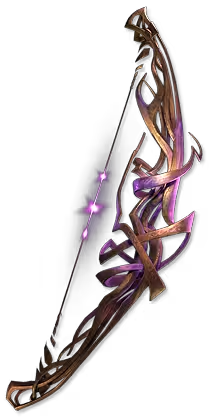 Voltaxic Rift allows Chaos Damage from Hits to Contribute to Shock Chance and
  Blood Barbs allows for Blood Mages to apply Bleeding with Elemental Damage. However, without special items or clever methods, a damaging Hit that only applies Fire Damage will never be able to Shock a monster.
What Do Each of the Ailments Do?
Non-Damaging Ailments
- Chill: Slows the afflicted target. Chill lasts for 2 seconds on players, or 8 seconds on non-players by default
- Freeze: Causes the target to be unable to move or act. Freeze lasts for 4 seconds by default.
- Shock: Causes targets to take 20% increased damage. By default, this lasts for 4 seconds on players, or 8 seconds on non-players
- Electrocute: Interrupts the target's actions and prevents them performing any actions. This lasts for 5 seconds by default
Damaging Ailments
 Bleeding: deals Physical damage over time and lasts for 5 seconds by default. Bleeding also bypasses Energy Shield and deals an extra 100% damage while the target is moving or if the Bleeding is Aggravated. The base Magnitude (size) of Bleeding is equal to 15% of the the Pre-mitigation Physical Damage of the Hit that inflicted it. "Pre-mitigation" means the damage taken before it is reduced by things like Armour. This means that the bigger the Physical Hit, the bigger the Bleed.
 Poison: deals Chaos damage over time and lasts 2 seconds by default. Damage from Poison bypasses Energy Shield. The base Magnitude of Poison is Chaos Damage per second equal to 20% of the Pre-mitigation Physical Damage of the Hit that inflicted it. Unlike in PoE 1, by default, only one Poison can be applied to an enemy at a time.
 - Ignite: deals Fire damage over time and lasts for 4 seconds by default. The base Magnitude of an Ignite is equal to 20% of the Fire Damage of the hit that inflicted it.
How Do You Apply Ailments?
The chance for an Ailment to be applied depends on the amount of damage dealt of a certain type by the attacker compared to the Ailment Threshold of the defender. Think of "Ailment Threshold" almost as the "Elemental Armour" that defends against the chance for an Ailment to be inflicted, similarly to how a suit of Armour would defend against a hit from a Sword.
Remember, the damage type also matters here: by default, even if you land a big Fire hit against a monster, you won't apply Shock, but rather an Ignite. Generally speaking, this means that the harder you hit, the greater the chance of applying an Ailment, but also the bigger the hit, the greater the Magnitude (the size or power) of that Ailment applied. However, this differs in some cases:
- Bleeding and Poison require a chance to apply those Ailments, and the default damage source needs to be Physical (in the case of Bleeding), or Physical or Chaos (in the case of Poison). If you land a big Physical Hit on an enemy but your chance to inflict Bleeding is 0%, you will not apply Bleeding to the enemy. You can increase this chance with Skill Gems, Support Gems, Passive Points on the Tree or with items and Ascendancy Points.
- Buildup: in the case of Freeze and Electrocute, landing more hits against a monster (while dealing the correct damage type) will cause Buildup of these Ailment types. Once the Buildup reaches 100%, the Ailment will be applied. Increased Freeze and Electrocute Buildup can be found on the Passive Tree, Gear and Items and Skill and Support Gems
- Chance to Inflict Ailments: you can increase the chance to apply Ailments to an enemy with Points on the Passive Tree, Gems and Support Gems and Items
- Increased Magnitude: You can increase the Magnitude (size and effect) of an Ailment with Points on the Passive Tree, items and Skill and Support Gems. This is another way to land big Ailments on enemies without increasing your damage
Of course, there are many ways to increase the type of damage you're dealing, which in turn can affect the chance to apply Ailments and their Magnitude, but the above section covers the basics
How Do You Avoid Ailments?
Elemental Ailments
A player's Ailment Threshold (chance to avoid having an Ailment inflicted on them), is based on half of their Maximum Life. This means that the more Life you have, the lower your chances of being affected by an Elemental Ailment. Do note that this only applies to Elemental Ailments
Ailment Threshold can also be increased with some Passive Points, with the Permanent Buff Quest in Act 3, and with some Items and Skills.
There are some ways to be entirely immune to certain Ailment types. For example
 Crystallised Immunities on the Passive Tree can make a player immune to certain Elemental Ailments depending on the number of Support Gems of a specific colour they have equipped
 Heatproofing from the Smith of Kitava can make that class Unaffected by Damaging Ailments
 - Fire Resistance will reduce the damage taken from Ignites
Poison and Bleeding
The chance for Poison and Bleeding to be inflicted is based on the chance for that Ailment to be applied and isn't calculated with the same Ailment Threshold formula. However, the amount of damage dealt by Poison and Bleeding can be reduced in other ways:
 Chaos Inoculation makes a character Immune to Chaos Damage (including Poison) and Bleeding
- Not moving while affected by Bleeding will help you to avoid taking the extra 100% extra damage while moving from Bleeding.
- Chaos Resistance will reduce the amount of damage you take from Poison
Charms
Charms are another great way to become temporarily Immune to certain Ailments. Players can equip up to three Charms and they will trigger once certain conditions are met.
 Silver Charm Your speed is unaffected by Slows, Used when you are affected by a Slow
 Thawing Charm Immune to Freeze, Used when you become Frozen
 Staunching Charm You are Immune to Bleeding, Used when you start Bleeding
 Antidote Charm Immune to Poison, Used when you become Poisoned
 Dousing Charm Immune to Ignite, Used when you become Ignited
 Grounding Charm Immune to Shock, Used when you become Shocked
You can read more about Charms in Dreamcore's Charm Guide
How Do I Know If I'm Affected By an Ailment?
You can often visually see or hear when your character is affected by an Ailment (for example, they will appear on Fire if they are Ignited), but you can also see by looking at the top left side of the screen for a list of Buffs and Debuff icons. Remember that you can always hit the Esc key to pause and hover over each of these icons

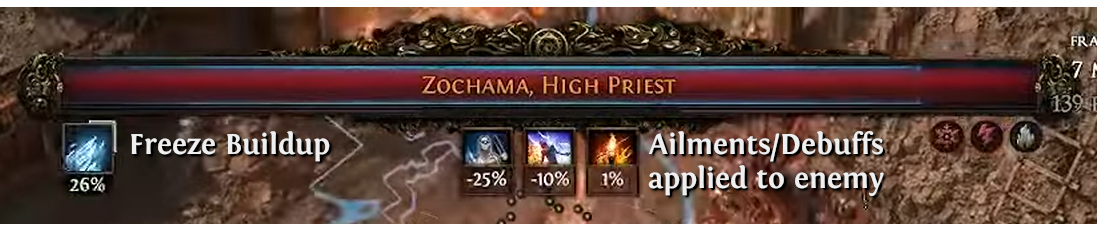
You can also see the Ailments or Buildup you have applied to an enemy under their Health Bar