
In this Ironclad guide for Slay the Spire 2, we'll cover the fundamental strategies to help you build decks and master the character.
 Use your favourite features in-game with our Desktop App
STS 2 Slay the Spire 2: Ironclad Guide and Overview
Overview
The  Ironclad returns in Slay the Spire 2, remaining the stalwart, heavy-hitting powerhouse of the Spire. As the last of his kind, he continues to leverage his demonic pact to crush foes with sheer physical might and hellish resilience.
Centralizing attributes revolve around life loss with cards like 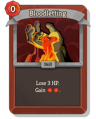 Bloodletting and
 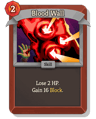 Blood Wall, as well as more common access to targeted and mass exhaust with cards like
 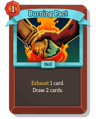 Burning Pact and
 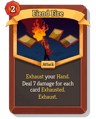 Fiend Fire
His starting Relic is  Burning Blood which heals him for 6 health at the end of each combat.
This guide is written by Japanese Export

All Ironclad Cards
Strengths & Weaknesses
- Forgiving with
 Burning Blood
 - Straight forward gameplans to follow that are reasonably consistent and successful
- Has the most explosive access to energy and draw
- Requires good understanding of deck manipulation and exhaust in order to master
- Lack of access to weakness aside from
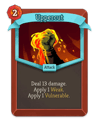 Uppercut
 - no access to
 Retain
Builds/Decks and "Bridge" cards
Rigidly adhering to a build is always a trap in slay the spire, but archetypes can often function nicely with a few key/core pieces. It is very likely that an optimal deck is always going to be combining multiple archetypes to solve different problems. Decks often need to solve damage and block requirements, but can do so with a mixture of different card packages. We will discuss the different ways to do so below
Instead of builds, we can think of cards as "bridging" you into synergy spaces. You can often classify "build" cards as "enablers" or "payoffs"
For example, Bloodletting is a "life loss" enabler but is also just a standalone strong effect in order to play more cards and get powers setup. Combining Bloodletting with 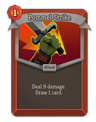 Pommel Strike is a good effect completely ignoring the "lose 3 hp" effect. Bloodletting is a strong individual pickup without synergy in the deck at all.
In this way, Bloodletting can bridge you into pure payoffs like 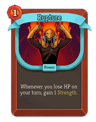 Rupture that would otherwise almost never want to enter the deck. A "Bridge" card essentially allows you to pick synergy pieces while not being dead weight without them
Cards like 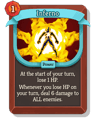 Inferno serve as both a "payoff" and an "enabler", as it both helps you take advantage of other life loss cards inside of the deck, and proc the aforementioned pure payoffs like Rupture
Some payoffs are simply so good that they are worth adding before any synergy (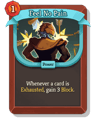 Feel No Pain
 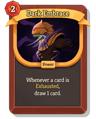 Dark Embrace etc.), just be aware that they are going to be negative in the short term and can help address a long term problem instead.
Dealing Damage
It is important to solve both frontload damage requirements AND scaling damage requirements in a run. There are multiple ways to do both, and several cards cover both categories. Some, but not all of the ideas are listed below to give examples of what you might look to take
Frontload Damage examples
- Pommel Strike is both a decent early game option and a scaling card into end game
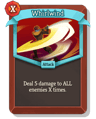 Whirlwind is a solid AoE pickup that gets stronger later through
  Strength and energy gain, is much stronger with an early upgrade
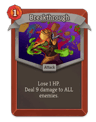 Breakthrough a solid AoE card that bridges into life loss synergies later
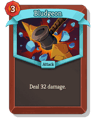 Bludgeon a very dense act 1 damage cards, excels especially in overgrowth
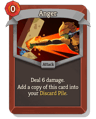 Anger very strong card that converts draw into damage, and plays well with
 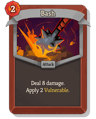 Bash as an expensive vulnerable source in the starter deck
 Tremble an incredibly powerful early pickup that scales well into late game
Scaling damage ideas
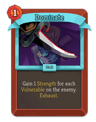 Dominate is the premium Strength scaling option for ironclad, and provides early vuln as well, a strong card at all points in the run. Simple and effective to use
- Fiend Fire can enable you to exhaust a large amount of cards from your deck, allowing you to create small loop decks that play something like
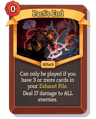 Pact's End multiple times a turn.
 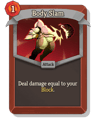 Body Slam if you are able to generate large amounts of block without payoff can convert block into damage, especially potent with an upgrade
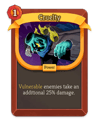 Cruelty is one of the best damage multipliers in the game and almost always going to be strong if the enemy is consistently vulnerable
Tips
 Vulnerable is a 1.5 damage multiplier, it is almost always going to be beneficial to make sure the enemy is vulnerable. Bash can be replaced with more premium options very quickly such as Uppercut or a
  Taunt+. It is advisable to find other vulnerable sources early
Blocking
Similarly to dealing damage, It is important to solve both frontload block requirements AND scaling block requirements in a run. There are multiple ways to do both, and several cards cover both categories. Some, but not all of the ideas are listed below to give examples of what you might look to take
Frontload Block
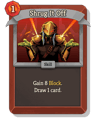 Shrug It Off a very simple improvement to the base deck, yet effective
- Blood Wall activates life loss synergies while being a large amount of block output. Dense cards like this are nice when you do not have much draw
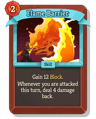 Flame Barrier a premium block card, deals damage while blocking at the same time, works especially well versus multi hit enemies
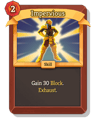 Impervious the best of the best, huge block number, right away, no drawbacks
Scaling Block options
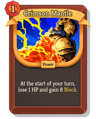 Crimson Mantle one of the absolute best block powers, activates life loss synergies and is a lot of output for one energy
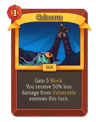 Colossus scales its amount of block with the amount of damage that the enemy deals, very strong at all points in the run
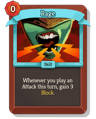 Rage scales with the amount of attacks you can play per turn. Your expected output generally increases throughout the run as you gain more access to energy and draw
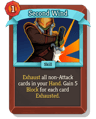 Second Wind large burst block that combines well with Feel No Pain. Can enable you to loop Colossus or your best block card after exhausting down.
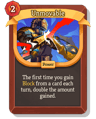 Unmovable is an excellent power, it works the turn you play it which allows you to avoid a lot of chip damage while you set up.
- Uppercut is ironclads only access to weakness, weakness scales as the enemies hit you for more damage, and provides a lot of block in the end game
Tips
- Multiple sources of plating stack in a beneficial way,
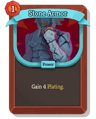 Stone Armor is especially strong with copies of itself or with
  Gorget
 - Ironclad generally struggles the most to block consistently as he lacks access to consistent sources of
 Weak, Colossus is generally the best replacement for this but is obviously only 1 card in the entire pool
 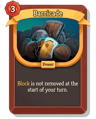 Barricade can be difficult to make work due to the aforementioned point, it is often better to just try to kill quickly rather than try to outlast the enemy, as a lot of your best block options cost health as well
Acceleration
Acceleration describes the ability of a deck to increase the amount of cards it can play, you can accomplish this in multiple ways, such as creating energy through  Pyre, or drawing more cards with something such as
 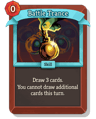 Battle Trance
Often, it is the combination of both energy and draw that makes a deck really succeed
Commons
- Bloodletting - probably the most single most important card in ironclads kit, enables many strategies and plays very well with other commons such as...
- Pommel Strike - another bread and butter acceleration piece for clad. Becomes draw positive only after the upgrade, but is a solid pickup even in later acts if you can upgrade it.
Uncommons
- Battle Trance - the first copy is almost always extremely positive to add, an instant click if it is not up against competing cards
- Burning Pact - targeted exhaust is a very powerful tool for ironclad, allowing you to get rid of base cards and thin your deck down to a small loop of cards. I common idea is to pick Bloodletting alongside Burning Pact as a main acceleration engine
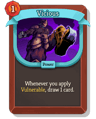 Vicious - significantly better with the upgrade, usually much better with 1 energy vulnerable application like
 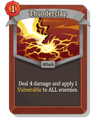 Thunderclap and Tremble
Rares
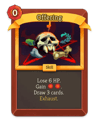 Offering - the best of the best, and a big contender for best card on the class. Draw and energy in one package is absurdly powerful
- Dark Embrace - can combine with other cards to be a main draw engine (such as the ancient only
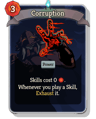 Corruption).
 - Fiend Fire - while this may not initially read as acceleration, exhausting 5+ cards at once when combined with draw can be equivalent to playing multiple deck cycles worth of Burning Pact. One of the main enablers to get down to a looping deck
Tips
- "loop" decks refer to decks that want to play the same sequence of cards over and over again. Ironclad very frequently can exhaust down to these ideas even with decks that are 30+ cards large. When thinking about this strategy, consider the "end goal" or the actual loop of cards you would like to play.
- For example: with 3
 Energy and 2
 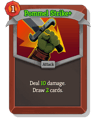 Pommel Strike+, you can play 3 instances of Pommel Strike+. If you include a 0 cost attack such as
 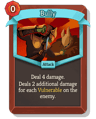 Bully, you can also play 3 instances of Bully, by alternating Pommel Strike+ with Bully.
 - These loops can be significantly more complicated, or "infinite" adjacent, if you include energy generation such as Bloodletting, or cards that draw 3+ such as
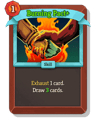 Burning Pact+
 - These kinds of ideas are often used when you cannot find other ways to scale, such as generating a lot of Strength