menu
MobalyticsUse your favourite features in-game with our Desktop App
PoE 2 Guide

The ABC of Currency Flipping & Making Profit

Currency
Updated on Feb 27, 2025
Feb 27, 2025

Overview

Currency flipping is the art of buying low and selling high.

But there's more to it than just that.

A flipper can be either a nuisance to other players - or part of a support infrastructure that boosts the efficiency of those other players while taking a cut for themselves in an arrangement everyone is happy with.

This guide assumes you are already familiar with the Currency Exchange. Lolcohol has written a great beginner guide to it here.

A Quick Note for Path Of Exile 1 Players

Every principle in this guide applies to the first game too.

Numbers and the specifics of commodities may differ.

For example, in POE1 requesting a Chaos Orb from your trade counterparty costs 25 gold, where in POE2 it costs 160. Gold is harder to get in POE1 than POE2.

Scarabs (which do not exist in POE2 yet) are among the most lucrative items to flip.

Types of Currency Flipping

There's three main forms of currency flipping.

Trade Sniping, Arbitrage and Swing Trading.

Trade Sniping

Trade sniping will NOT be covered in depth in this guide, as many players consider it to be unethical or even unconscionable conduct.

Trade sniping involves profiting from mistakes other players make.

Someone lists a Divine Orb for 130 exalts when 275 is the fair ratio? You snap it up and resell it.

Someone lists an unidentified or premium roll Morior Invictus or Prism of Belief at the price of a poor roll? You trade snipe it and relist it.
Someone posts a truly phenomenal rare item on Reddit that you know you could sell for 120 divines? You have your three Reddit accounts say "yeah it's not as good as you think but you might get 12-15 divines" then on your real account offer 20. (This is the nastiest example here; trade sniping can get worse and I won't disclose the nastier strategies)

Sniping will make you simultaneously wealthy and hated.

Doing so via flagrantly dishonest means may close some doors within the POE2 community, for example, potentially getting you added to scammer blacklists that are circulated by various guilds and discords. You may not even be aware that those doors are closed to you or why - negative consequences can be silent.

What defines trade sniping - rather that arbitrage or swing trading - is that the other party to the trade would regret trading with you immediately if they were knowledgeable about the game's economy.

I do not recommend engaging in this.

Fundamentally, this is not a PVP game. Loot monsters rather than other players, you'll have more fun that way.

Arbitrage

This is the main form of 'flipping' in POE2.

Imagine this scenario.

You are just getting started in maps, and you had a really good drop in your sixth map, a Greater Essence of Torment.

You have three choices: sell it instantly for 24 Exalted Orbs, list it for sale at 30 Exalted Orbs and maybe get a sale in the next 24 hours, or plan upon selling it when you have enough to sell a divine's worth at once, and forget about it.

It's not irrational to take the instant 24 Exalted Orbs here. Plenty of people do so. This allows them to make immediate improvements to their characters, helping find the next good drop sooner.

In the real world, arbitrage means buying in one market to resell at a higher price in another. For example, purchasing collectibles in Japan then reselling them in Australia where they are scarce.

In POE, there's only one market - but you can still be an intermediary between sellers with one of an item and buyers who want twenty of that item. Or between sellers who want currency right now, and a buyer who desires the item tomorrow.

Arbitrage trading is all about buying low and selling high on items that you do not expect to undergo wild price changes.

In the earlier example, arbitrage trading is being the person buying the Greater Essence of Torment for 24ex. You provide the seller instant liquidity, and then sit on it until you can resell it for 30ex.

Or maybe you elect to resell for chaos orbs or divine orbs instead, because you can get a better price there.

More on Arbitrage strategies later.

Swing Trading

This is much less of a thing in Path of Exile 2 than in real life markets.

The basic idea is that you sincerely believe an item will increase in price due to either an increase in demand, or a decrease in supply.

This can be done with currency items OR with items that can be equipped, although the latter cannot be done via the Currency Exchange.

For example - imagine you are watching Jungroan stream and he mentions a desire to build around a previously unpopular spell such as Firestorm. You might conclude "Any Firestorm build probably desires a weapon crafted with Greater Essence of Fire and a well rolled or well corrupted Fireflower amulet"

At this point, it's not unreasonable to start purchasing Greater Essence of Fire or Fireflower with a view to reselling them later once hype is higher, after the demand spike. If you understand all the intricacies of how Vaal Orbs work, you might also pick up Distilled Emotions and Xoph's Catalysts.

Alternately, Ben_ might stream a strategy involving the Ritual mechanic and farming the access key for the King in the Mists encounter. You might watch this and be one of the first to conclude "if more people do this, that means more people using Ritual tablets and thus less people using Breach tablets - maybe this will make Breachstones more expensive".

In this case, you might conclude that trading for Breachstones is a good idea due to a potential future supply drop.

Or you might discover a completely overpowered build utilizing a little known unique and buy 72 of that item before going public with your findings.

The key difference between swing trading and arbitrage is that with swing trading, you have no expectation of reselling quickly.

And if you make a mistake in swing trading, you will lose more.

Terminology: Buy Orders, Sell Orders, Blocking Orders

In this guide, an 'Instant Match Order' is where you make a trade offer that someone else has already agreed to. For example, another player lists their 3 Greater Essence of the Body for 17 Exalted Orbs and you accept their offer, immediately receiving your Essences.

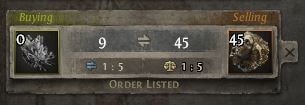
A 'Buy Order' is an order that is not an 'Instant Match Order' where you offer to pay for a commodity using Exalted Orbs, Chaos Orbs or Divine Orbs. Example:

This is a buy order. I am offering 45 Exalted Orbs, one of the most traded commodities in the game, and requesting a more esoteric item, 9 Greater Essence of Ice.

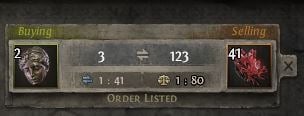
A 'Sell Order' is the opposite. Again, it's not an 'Instant Match Order' so it will not instantaneously fill. The esoteric item is what I am offering - in this case, 123 Greater Essence of the Body, and I'm requesting 3 Divine Orbs. So far, two trade counterparties have agreed to this offer and each paid one Divine Orb for 41 essences, but the last essences remain unsold.

Example:

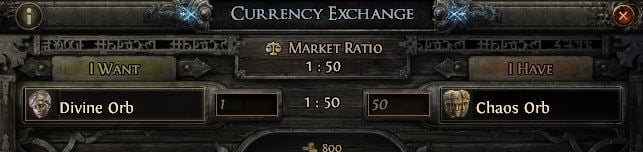
Finally, a 'Commodity Trade' is when you swap the three main currency items for each other.

Example:

You may also dream up another type of trade, a commodity barter (example: listing 2 Greater Essence of the Body and requesting 3 Greater Essence of Ice in exchange).

These are never recommended, as no potential trade counterparties will think to look for your trade.

Finally, a 'Blocking Order' is an order so large or so poorly priced that you do not expect it to fill promptly. If there are multiple blocking orders, only the most competitive one matters.

For example, if 3 Breachstones are listed at 167 exalts each, 272 at 168 exalts, 13 at 169 exalts, 2410 at 169.5 exalts and 1 at 16773 exalts - the 272 item order is the blocking order. The less competitive 169.5 and 16773 exalt orders won't fill unless/until the blocking order is cleared, which would require hundreds of Breachstones to sell.

The First Rule Of Swing Trading

We'll cover swing trading first because it's the easier topic to cover. This one is important.

Swing trading is betting that your predictions about the game's future are correct. Nothing more, nothing less.

Sometimes you'll be wrong, and you'll lose everything you put into swing trading.

Other times, you won't be wrong, and you'll get a lovely surprise.

Always assume your predictions could be wrong, and if you are not OK with the consequences of being wrong - don't make a swing trading bet.

Swing Trading - Other Tips

There isn't much more to say here.

The more you know about the POE2 metagame, the more effective you will be at swing trading, but it is always a huge risk.

Pay attention to rising posts on the Path of Exile 2 and Path of Exile 2 Builds subreddits, Youtube videos from big name content creators that are under an hour old, and Grinding Gear Games announcements that might shake up the metagame in some way.

But ultimately remember - you are making a bet, and other people are also making bets at the same time. Consider the possibility that some of them are very, very smart and have thought two steps further ahead than you have. They might have bought out a commodity within a minute of a big Reddit post, aiming to resell to other, slower swing traders!

Arbitrage Trading Tips - Choosing Items

This guide will not provide a list of good commodities to flip as it is essential to trade in different commodities to other players.

I cannot provide a list that is 'forever'. You will need to discover your own.

I made much of my 0.1.0 wealth flipping Greater Essence of the Body.

You want to carry out arbitrage on items that meet the following criteria:

  • They are stackable and thus can be listed on the Currency Exchange.
  • At least a small number of wealthy players want a very, very large amount of this commodity.
  • Gamewide demand exceeds supply (I call this the 'Regal Orb Rule' - Regal Orbs are genuinely useful, but across a mature trade league, enough Regal Orbs exist that few players want to trade for them and even fewer want them in bulk)
  • You can afford this item in significant bulk.
  • The number of other players flipping this commodity is as small as possible. More expensive commodities attract more flippers.

And most importantly:

  • These items drop in small quantities for a large number of players, meaning players do not get one and think "oh, I'll get nine more of those today, let's sell when I have ten".

Consider the aforementioned Greater Essence of the Body.

It is stackable.

Most players don't really want to use them, but players crafting life-based rare chests, helms, gloves and boots at least consider using them. And while many of those players are not wealthy, some are.

This Essence is very rare (unlike the Lesser Essence version)

A player with two divine orbs can afford a lot of them (in the 0.1.0 economy; this might change).

From trial and error, I discovered almost no-one else was flipping them. If others get into this market, I can move on to ten or twenty other items with similar properties such as the other Essences, or those Omens that modify Alchemy Orb behavior.

And finally, this Essence doesn't really drop in bulk for any particular playstyle. Someone with an Atlas that optimizes Essences will get occasional Greater Essences, but they will not consistently be this one.

These are the criteria to start arbitrage trading. Keep checking, to see if they still apply over time.

Arbitrage Trading Tips

Gold

Arbitrage trading requires a lot of gold!

Much more so than other playstyles. So get out there and map!

Run the highest tier waystones you can run without any significant slowdown, which will be tier 15 or 16 if you have an overwhelmingly powerful character, but for many players may be tier 10 waystones. Tier 10 and lower Waystones have easier area modifiers than 11-16.

Buy Order Pricing

The most common approach traders take to buy order pricing is to outbid the current highest offer by the smallest amount possible.

I do not recommend this approach.

Instead, I advocate outbidding only blocking orders, unless there's only a small price differential between the blocking order and the best priced order.

This way, anyone selling a significant amount of the commodity will clear out all the higher prices and ensure other players have to sell to you.

Sell Order Pricing

This is simply the reverse. Undercut blocking orders by the smallest practical amount.

This strategy of ignoring small orders and undercutting/outbidding only blocking orders decreases your turnover, but increases your margin. In my experience, it's the better overall option.

As you gain experience, you will realise that there are times to deviate from this - especially if you identify that the market is moving in a particular direction.

Combining Swing and Arbitrage Trading - The Wildest Rides

Sometimes, you will identify reasons you think a commodity will increase or fall in value. As an example, I identified that the 0.1.1 patch would result in the Exalted Orb cratering in value relative to the Divine Orb.

At this point, you can combine Swing and Arbitrage approaches. As more players notice they will either buy (as a result of 'fear of missing out') or sell (as a result of 'fear of not getting out').

This means more turnover, which usually leads to wider profit margins. But it can also be a wild and risky ride.

How To React:

If you believe the commodity will rise in price, aggressively outbid on your buy orders and do not undercut much at all with your sell orders.

If you believe the commodity will fall in price, aggressively undercut on your sell orders and do not outbid much at all with your buy orders.

When You Need To Log Off - Sleep and Workdays

POE2's market moves fast.

If at all possible, do NOT log off for an extended time (not even to go to work) without first cancelling all sell orders and setting a huge competitive buy order if you believe the direction is up.

If you think the direction is down, instead, aggressively undercut to sell all of your stock and cancel any buy orders you have up.

Of course, real life comes first. Better to miss a divine in potential profits than be late to picking up your kid from school.

Arbitrage - Choosing Exalted Orbs, Chaos Orbs or Divine Orbs

Which should you price your orders in?

Gold Costs

When you place a sell order or commodity trade, you will be charged a fee based upon the currency you are requesting. This fee is not refunded if you cancel your order, although you will receive an automatic pro-rata refund if the game cancels it for you.

This fee is:

120 gold per exalted orb you request

160 gold per chaos orb you request

800 gold per divine orb you request

The same principle applies to buy orders, but other commodities have much more varied prices. For example, 1000 gold per Orb of Chance, 1 gold per Scroll of Wisdom, and fixed fees for each Essence, each Catalyst, each Distilled Emotion etc.

Soon before patch 0.2.0, the value of the Exalted Orb completely collapsed, and 1 Divine Orb was worth 50 Chaos Orbs which was 550 Exalted Orbs.

In this economic context you can see that if you request exalted orbs, you are going to need to spend 66000 gold per Divine Orb in turnover. If you are making a relatively high margin - buy at two-thirds of your sell price - you are only making one Divine Orb per (approx) 200000 gold.

This is why many traders started encouraging small trades to be in chaos rather than exalts.

Every Seller Has A Story...

When you post a buy order for a commodity, try to profile the people you think might be selling to you.

For example, you post an order for Greater Essence of Torment, which prior to 0.2.0 was often the most expensive Essence.

These can drop for anyone at endgame, but most players selling won't have many of them. There's a category of people who will be excited to see one drop and to sell it, however - those newer to endgame, for whom it is one of the best items that has dropped so far.

What does that newer to endgame player want? Given that they can't afford a Divine Orb, they likely want Exalted Orbs - both for trade and to apply to their own items present and future. While Chaos Orbs are great, they aren't useful on early gear.

So based upon this profile, I would typically list a buy order in Exalted Orbs.

Contrast this to a commodity like An Audience with the King - someone completing a Ritual encounter in sufficiently high tier maps to obtain that invitation almost certainly wants Divine Orbs.

It is, however, also perfectly fine to experiment with other currencies

... As Does Every Buyer

A wealthy crafter who is mass-producing lightning spell wands may spend so much on wand bases that the cost of the small number of Greater Essences is a rounding error.

This person sells their crafted items in Divine Orbs and may not even think to look in lesser currencies. They probably don't keep large amounts of exalts or chaos on hand.

To deal with this person - you want to be selling in Divine Orbs.

You could sell to someone else - but likely, the wealthy crafter will outbid them, because they can afford to and to them, time is money.

In Short

Offer exalts and/or chaos when placing buy orders that are under one Divine Orb individually, so you can buy from people who have only one of the item. You can set one buy order in exalts and another in chaos, if you have spare order slots and are not concerned about the risk of both filling.

Default to selling large bulk of crafting commodities in Divine Orbs.