In this Palworld elements guide, we’ll cover what the elements are, how they have strengths and weaknesses against each other, and the work suitabilities they’re associated with.
If you’re coming from the Pokémon world, you’ll be very familiar with the elemental type system – however, there are a few differences in comparison to Palworld’s.
Let’s dive in!
What are Palworld Elements?
In Palworld, every Pal has at least one elemental type (some have more). This usually ties into their appearance, name, and abilities.
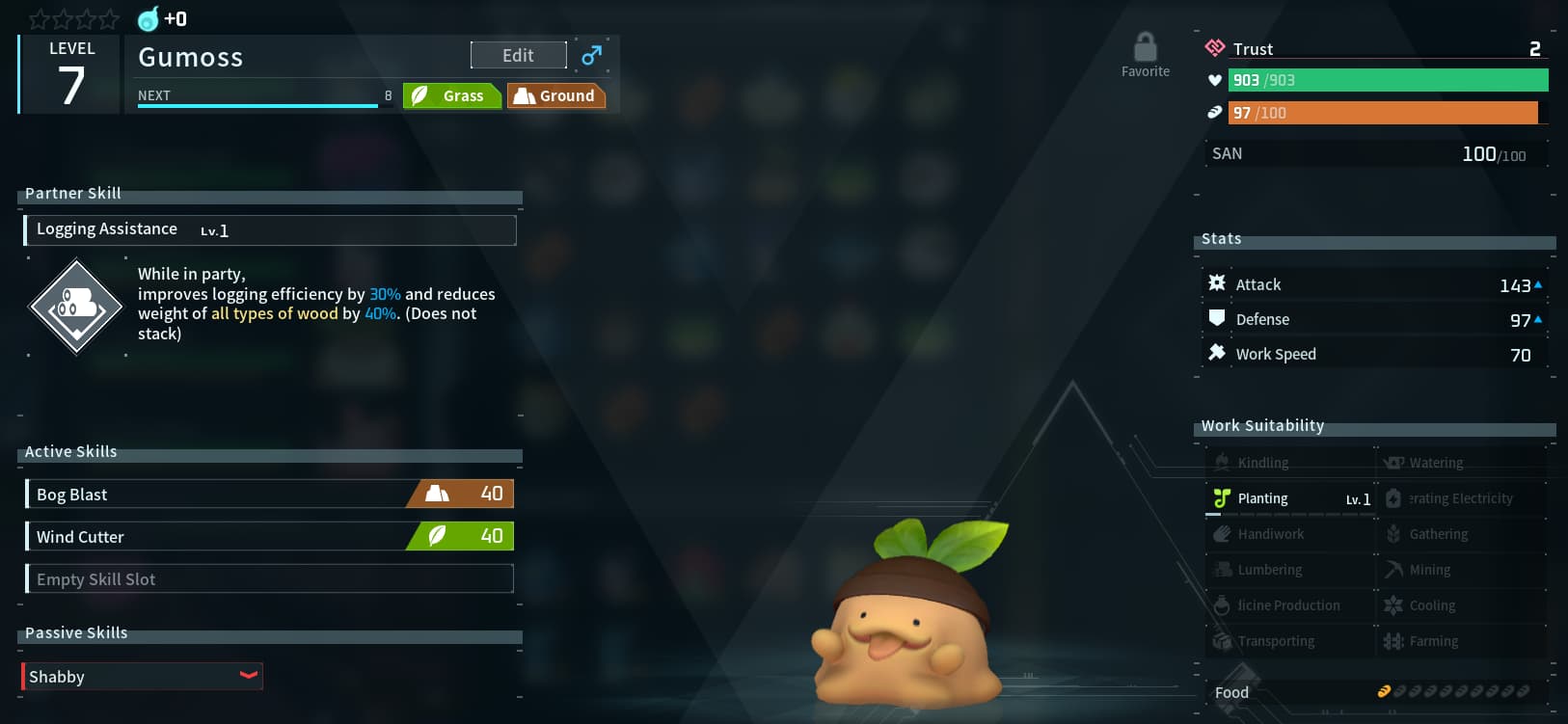
Let’s take a look at Gumoss, a useful early game Pal as an example. To find a Pal’s elements, just check your Paldeck.
Gumoss is one of the Pals that has two elements, Grass and Ground. This means that it will naturally learn Active Skills (the abilities Pals use in battle) as they level up.
Right now, it has Bog Blast (a Ground attack) but will learn abilities like Wind Cutter (Grass) next.
In addition to Active Skills, you also have a Pal’s Partner Skill. Partner Skills can be active abilities you cast on a cooldown or passive bonus effects.
Gumoss's Partner Skill is Logging Assistance, which helps you cut trees faster. Although this is sort of a funny relation to its elemental theme since it’s encouraging you to kill other plants…
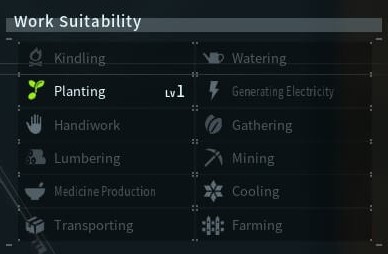
Lastly, Gumoss's Work Suitability is one level in Planting. We’ll cover Work Suitability and its relation to the elements in more detail in a later section.
Overall, the main takeaway is that the Pal’s element ties into their theme and function, both in and out of combat.
The Elemental Chart (Strengths and Weaknesses)
Just like one of its obvious influences, Pokémon, Palworld includes an elemental rock-paper-scissors system.
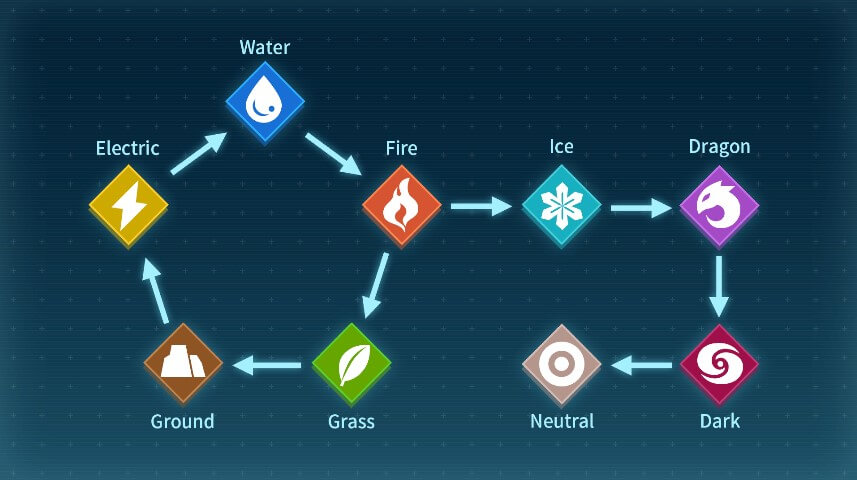
Every type of element has interactions with specific other elements. Here’s a look at the in-game chart from the Survival guide.
Source: The in-game Survival Guide
The arrows pointing toward an element mean that the element is stronger against that element. So for example, Water –> Fire means Water attacks deal more damage against Fire-type Pals.
This also means that Fire Skills do less damage against Water-type Pals.
Here’s a chart version if the arrows are weird to follow:
Element
Strong Against
Weak Against
Dark
Neutral
Dragon
Dragon
Dark
Ice
Electric
Water
Ground
Fire
Grass and Ice
Water
Grass
Ground
Fire
Ground
Electric
Grass
Ice
Dragon
Fire
Neutral
None
Dark
Water
Fire
Electric
Something to note is that Fire is strong against both Grass and Ice while Neutral is not strong against anything.
Differences from Pokémon’s Type Chart
If you’re a Pokémon player you’ll feel right at home with Palworld’s elemental system, but there are some differences to take note of:
Grass doesn’t beat Water
No Ghost, Psychic, Fairy, Bug, Poison, Fighting, Rock, or Poison.
There aren’t any elemental interactions that cause 0 damage (like Normal vs Ghost, Electric vs Ground, or Ground vs Fly)
Elements and Work Suitability
Although Palworld is similar to Pokémon and other monster tamers in many ways, there are also aspects that make Palworld distinct.
One of those key differences is Work Suitability, which refers to how your Pal contributes to your base if they are stationed there as a worker.
The twelve Work Suitability skills are:
Kindling
Watering
Planting
Generating Electricity
Handiwork
Gathering
Lumbering
Mining
Medicine Production
Cooling
Transporting
Farming
Although there are some exceptions, a Pal’s element and general theme will usually indicate what sort of work they’ll be good at.
Here’s a breakdown of the crossover, note that we mean that there is at least one Pal of the element that has the skill, they do not all the possible skills listed:
Dark and Neutral
These are paired together because Pals of these elements tend to do a lot of things.
Mining
Transporting
Farming
Gathering
Handiwork
Kindling (only Dark, no Neutral)
Lumbering
Medicine
Dragon
Dragon is another very versatile type since it’s often in combination with another element.