Damage Conversion is split into two categories: Damage Conversion and Damage Gain. Each of these is a type of Damage Conversion, with their own mechanics. Damage Conversion also follows an important two-step process to ensure that there are no conversion loops, which we've detailed below. Both Damage Conversion and Damage Gain modifiers are calculated prior to modifiers that scale Damage.
Note: Damage Conversion and Damage Gain only work for Hits. They do not interact with Damage over time in any way.
Damage Conversion
Regular Damage Conversion is a mechanic that changes one type of Damage into another type of Damage. For example 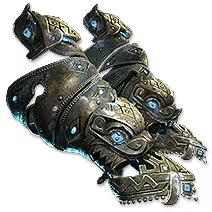 Blueflame Bracers have the modifier '100% of Fire Damage Converted to Cold'. This modifier will completely remove the source Fire Damage, fully converting it into Cold Damage. Importantly, Damage Conversion will only convert Hit Damage, and will not interact with Damage over time.
There are two types of Damage Conversion; Skill type conversion and secondary conversion. Skill type conversion is any conversion that exists on a Skill, for example  Perfect Strike. Secondary conversion encompasses all conversion modifiers that aren't inherently tied to a skill, such as those from gear like
  Valako's Vice or from the Passive Skill Tree, for example
  Avatar of Fire. The type of conversion is important as it's used to determine the order of operations for calculating conversion, detailed in the two-step process below.
Damage Gain
Damage Gain is a mechanic that provides extra Damage from a source type of Damage without removing the source Damage. For example  Burning Strikes allows you to gain extra Fire Damage from the Physical Damage in a Hit, but does not change the source Physical Damage in any way. Damage Gain only works for Hit Damage and does not interact with Damage over time.
Like with regular Damage Conversion, when Damage is gained, the resulting Damage is only scaled by modifiers to the new type. Taking the above example, the extra Fire Damage gained from Burning Strikes would not be scaled by modifiers such as 'increased Physical Damage', but would be scaled by modifiers like 'increased Fire Damage'.
Two-Step Process (Important)
All types of Damage Conversion occur in a specific order to prevent conversion loops. Conversion in step 1 and step 2 are not additive, see the below example.
Step 1: Skill Type Conversion
Any Damage Conversion that exists on a Skill occurs in the first step. For example the conversion inherently tied to  Volcanic Fissure is calculated in this step.
If inherent Damage Gain exists on a Skill, such as  Eye of Winter or
  Lunar Assault's Quality stat, it occurs in this step. This doesn't include global Damage Gain buffs even if they originate from a Damage Skill, such as
  Rend's Gain as Lightning Buff which occurs in step 2.
Step 2: Secondary Conversion
Any Damage Conversion modifiers that aren't inherently tied to Skills are all calculated and applied simultaneously in the second step, such as Blueflame Bracers. See the next section below for more detail.
Damage Gain that doesn't originate from a Skill, or any Damage Gain that's granted from a global Buff even if it originated from a Damage Skill, is calculated in this step. For example if you were using Perfect Strike with Burning Strikes, the Damage Gain would be calculated based on the remaining Physical Damage after conversion, as this is Skill type conversion which occurs in step 1.
As most of the Damage Gain modifiers and all of the secondary Damage Conversion modifiers are applied simultaneously in step 2, this means that Damage gained as extra Damage can only be converted under very specific scenarios. For example the extra Lightning Damage gained from  Archmage occurs in step 2 alongside the conversion from
  Call of the Brotherhood, therefore the extra Lightning Damage gained is not converted to Cold Damage. However, because
  Twister has inherent Damage Gain when coming into contact with Ground Effects, the Damage Gain modifier from this Skill occurs in step 1 and therefore any Damage gained in this way can be converted by regular Damage Conversion modifiers in step 2.
Step 1 & 2 Damage Conversion Modifiers
Damage Conversion modifiers that exist between each step are not additive with one another. For example a character has 1000 base Physical Damage and lands the perfect timing window portion of Perfect Strike resulting in '80% of Physical Damage Converted to Fire'. The character also has Avatar of Fire allocated, which converts 75% of all Damage types into Fire, but also prevents the character from dealing any non-Fire Damage. The end result is that the Skill type conversion from Perfect Strike is calculated first in step 1, resulting in 800 Fire Damage and 200 Physical Damage. Then the conversion from Avatar of Fire is applied in step 2, resulting in 150 Fire Damage, but also preventing any non-Fire Damage, removing the remaining 50 Physical Damage. The character therefore deals a Hit of 950 Fire Damage.
Conversion Over 100%
If Damage Conversion modifiers would exceed 100%, they're normalized to 100%. This occurs on a per-step basis, as Damage Conversion modifiers in different steps are not additive with one another. Note that Damage cannot be converted to the same type.
For example 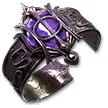 Original Sin has the modifier '100% of Elemental Damage Converted to Chaos Damage', while the
 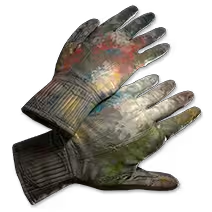 Painter's Servant Unique Gloves convert Elemental Damage split across all three types. A character using both items with
  Frost Bomb would have a base Hit of Cold Damage and a total of 166% of Elemental Damage converted to different Damage types (100% to Chaos, 33% to Fire and 33% to Lightning). This conversion would be normalized to 100% total conversion, resulting in 60% of Elemental Damage Converted to Chaos, 20% of Elemental Damage Converted to Fire and 20% of Elemental Damage Converted to Lightning.
Damage Conversion and Damage Scaling
Modifiers that scale Damage such as 'increased Damage' or 'more Damage' are applied to any Damage after conversion has taken place. Damage does not 'remember' its origin type(s), and is therefore not affected by Damage scaling modifiers other than those that would directly apply to the post-conversion Damage type. For example, Fire Damage that's converted to Lightning Damage using Valako's Vice is scaled by 'increased Lightning Damage' but not by 'increased Fire Damage'.