
 Use your favourite features in-game with our Desktop App
Overview
Guide
If you have any questions regarding this Guide feel free to also join my Discord -https://discord.gg/HzymKNKfrJ
How Armour Works in PoE 2 — Building Stronger Defences
Armour can make a big difference to your survivability, but the damage reduction shown on your character panel does not tell the whole story.
In this guide, I’ll explain how Armour works, why bigger hits are harder to reduce, and how to combine Armour with resistances and physical damage taken as elemental damage.
We’ll start with 50,000 Armour and the normal 75% resistance cap, then compare the results with 100,000 Armour and 90% fire resistance.
Note for patch 1.0: some unique items and passive notables may change.
1. How Armour Works
By default, Armour reduces physical damage from hits. It does not reduce physical damage over time.
Armour does not give you the same percentage of reduction against every hit. Its effectiveness depends on how much Armour you have compared with the size of the physical hit.
The formula used for these examples is:
Damage reduction = Armour ÷ (Armour + 10 × Physical Hit)
Let’s use 50,000 Armour against a 10,000 physical hit:
50,000 ÷ (50,000 + 100,000) = 33.3% damage reduction
You prevent about one-third of the damage, so you take approximately 6,667 damage.
With the same Armour, a smaller hit is reduced more effectively:
Incoming physical hit | Damage taken with 50,000 Armour |
|---|---|
1,000 | 166.7 |
5,000 | 2,500 |
10,000 | 6,666.7 |
Smaller hits: higher percentage reduction. Bigger hits: lower percentage reduction.
Damage reduction from Armour normally caps at 90%. Once you reach that cap against a particular hit, adding more Armour cannot reduce that hit further through Armour alone.
This is also why the estimated reduction on your character panel is not a guarantee against a boss. A much larger hit can get through a much larger percentage of your Armour.
2. How Resistances Work
Resistances are simpler: they reduce damage of the matching type by a percentage.
For example, with 75% fire resistance, a 10,000 fire hit becomes:
10,000 × 25% = 2,500 damage taken
You prevent 75% and take the remaining 25%.
The same principle applies to cold, lightning and chaos damage through their respective resistances. Chaos is a separate damage type and is not included in “Elemental Damage.”
The normal maximum resistance is 75%. You can raise this maximum through certain items and passives, up to 90%.
You need both a higher maximum and enough actual resistance to reach it. Having 90% uncapped fire resistance with a 75% maximum still gives you only 75% effective fire resistance.
For that same 10,000 fire hit:
Fire resistance | Damage taken |
|---|---|
75% | 2,500 |
90% | 1,000 |
Going from 75% to 90% resistance means taking 60% less damage of that element, compared with what you were taking at 75%.
3. Armour Can Also Apply to Elemental Damage
Ordinary Armour does not reduce fire, cold or lightning damage. You need a modifier such as:
“ 30% of Armour also applies to Fire Damage.”
This tells you how much of your Armour can defend against fire hits. It does not mean you automatically reduce fire damage by that 30%.
For example:
50,000 total Armour × 30% = 15,000 Armour used against fire
If you have 100% of Armour also applying to fire, the full 50,000 Armour works against the fire hit.
Your Armour is not divided between physical and fire damage. The same total can defend against each eligible damage type.
For these calculations, Armour uses the damage before resistance. Resistance then reduces what remains.
With a 10,000 fire hit, 50,000 Armour fully applying to fire, and 75% fire resistance:
Armour reduces 10,000 to approximately 6,667.
Fire resistance reduces that remaining damage to approximately 1,667.
The normal 90% Armour reduction cap also applies when Armour defends against elemental damage. This is separate from resistance: resistance can still reduce the damage left after Armour.
Example passives
Passive | What it provides |
|---|---|
| 25% increased Armour and 15% of Armour also applying to elemental damage |
| 30% of Armour also applying to elemental damage |
| 10% increased Armour, 30% of Armour also applying to fire damage, and reduced Ignite magnitude on you |


Elemental Damage includes fire, cold and lightning. A modifier that names only Fire Damage applies only to fire.
Our later examples assume 100% of Armour also applies to fire. That is a combined setup assumption, not the effect of any single passive listed above.
4. Physical Damage Taken as Fire
Another way to improve your defences is to change the type of damage you receive.
For example:
“50% of Physical Damage taken as Fire Damage.”
A 10,000 physical hit is now split into:
5,000 physical damage
5,000 fire damage
You still have 10,000 damage before mitigation. Nothing has been reduced yet.
The split happens before Armour and resistances apply.
Your Armour now defends against a smaller physical portion, making it more effective. The fire portion is handled by fire resistance, and by Armour too if you have the appropriate modifier.
This is damage taken as another type on defence. It does not change the damage your character deals.
Example items and passives
Item or passive | What it provides |
|---|---|
| 50% of physical damage taken as fire damage |
| A percentage of physical damage from hits taken as lightning damage |
| 5% of physical damage taken as fire damage, alongside an offensive fire bonus |
| 5% of physical damage from hits taken as damage of a random element, alongside increased elemental attack damage |
| Body Armour grants 25% of physical damage from hits taken as fire damage |
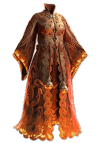


Pay attention to “from hits.” That wording limits the effect to hits. Cloak of Flame does not have that restriction on its damage-taken-as modifier.
Cloak of Flame’s 50% value can also be increased through a lucky corruption. A 60% version is one possible upgrade, but corruption is a gamble and can also make the value worse.
For the examples below, we’ll keep using 50% taken as fire.
5. Putting Everything Together
Let’s return to our 10,000 physical hit.
Our setup has:
50,000 Armour
75% fire resistance
50% of physical damage taken as fire
After the split, we have 5,000 physical and 5,000 fire.
Physical portion
Against a 5,000 physical hit, 50,000 Armour gives 50% reduction.
5,000 physical → 2,500 damage taken
Fire portion
With 75% fire resistance, we take 25% of the fire portion.
5,000 fire → 1,250 damage taken
Total
2,500 physical + 1,250 fire = 3,750 damage taken
With Armour alone, the original 10,000 physical hit dealt about 6,667. Adding 50% taken as fire and 75% fire resistance brings it down to 3,750.
Now add Armour applying to fire
Keep the same setup, but add:
100% of Armour also applies to fire damage
The physical portion stays at 2,500.
The fire portion now goes through both layers:
5,000 fire → 2,500 after Armour → 625 after fire resistance
Our new total is:
2,500 physical + 625 fire = 3,125 damage taken
What changes at 90% fire resistance?
The physical portion still stays at 2,500.
After Armour, the fire portion is still 2,500, but 90% fire resistance reduces it to 250.
2,500 physical + 250 fire = 2,750 damage taken
Setup against the original 10,000 physical hit | Total damage taken |
|---|---|
50,000 Armour only | 6,666.7 |
Add 50% taken as fire and 75% fire res | 3,750 |
Add full Armour applying to fire | 3,125 |
Raise fire resistance to 90% | 2,750 |
6. What Happens with 100,000 Armour?
Now double our Armour while keeping:
50% taken as fire and 100% of Armour also applying to fire.
The original 10,000 physical hit still splits into 5,000 physical and 5,000 fire.
With 100,000 Armour, each 5,000 portion receives approximately 66.7% Armour reduction.
The physical portion becomes approximately 1,666.7.
The fire portion also becomes approximately 1,666.7 before resistance.
Fire resistance | Physical taken | Fire taken | Total taken |
|---|---|---|---|
75% | 1,666.7 | 416.7 | 2,083.3 |
90% | 1,666.7 | 166.7 | 1,833.3 |
Compared with 50,000 Armour, that is a substantial improvement against this larger hit.
7. Comparing Smaller and Bigger Hits
These tables start with pure physical hits.
Every “split” setup has 50% physical damage taken as fire. “Armour on fire” means 100% of your total Armour also applies to fire.
All results are total damage taken, rounded to one decimal place.
With 50,000 Armour
Raw hit | Armour only | Split, 75% fire res | Split + Armour on fire, 75% res | Split + Armour on fire, 90% res |
|---|---|---|---|---|
1,000 | 166.7 | 175 | 62.5 | 55 |
5,000 | 2,500 | 1,458.3 | 1,041.7 | 916.7 |
10,000 | 6,666.7 | 3,750 | 3,125 | 2,750 |
With 100,000 Armour
Raw hit | Armour only | Split, 75% fire res | Split + Armour on fire, 75% res | Split + Armour on fire, 90% res |
|---|---|---|---|---|
1,000 | 100 | 175 | 62.5 | 55 |
5,000 | 1,666.7 | 1,125 | 625 | 550 |
10,000 | 5,000 | 2,916.7 | 2,083.3 | 1,833.3 |