

Edward Kenway
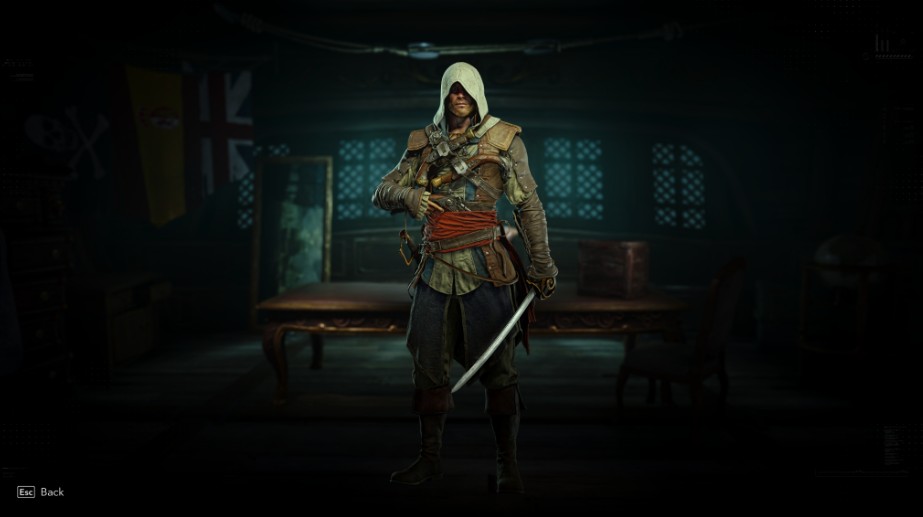
Edward James Kenway was born on the 10th of March in Swansea, Wales, to Bernard Kenway of Manchester and Linette Hopkins of nearby Cardiff. By Edward's 10th birthday, his father had moved the family to a small farm just outside Bristol, a nearby port town in the southwest of England.
This relocation had a depressing effect on young Edward's mood. He grew restless from a lack of contact with old friends and struggled to find an outlet for his limitless energy. By his teens, he was spending more and more time in the city away from his farm, where the lure of excitement overrode prudence. By age sixteen, he had substituted a career as a successful farmer for a life of hopeless tomfoolery, frequently shirking his responsibilities to his family in favour of rough company.
In late 1711, at the age of seventeen, Edward met Caroline Scott, a woman of modest but steady means. Their friendship began cautiously, as Caroline's hand had already been promised to the boorish son of a wealthy East India Company executive. But Edward's charms eventually won out, and he and Caroline were married within a year of their meeting; a union that angered her father and got the whole of Bristol talking.
In the earliest months of their marriage, Edward resolved to do well by his wife and provide for her as he believed a man in his position should. But his grandiose dreams and exaggerated self-esteem prevented him from taking immediate responsibility for their well-being. And after only a year, he had stumbled back into his worst habits—drinking, fighting, and idleness.
It was in this dark period that Edward revived an old idea of joining a privateering fleet sailing for the West Indies, with the aim of making war against the Spanish and collecting unchecked sums of gold and cargo. This, he told his wife, was their path to quick riches. Being a sensible and prudent woman, Caroline discouraged these fanciful ideas.
By the summer of 1712, Caroline understood that her husband's departure was inevitable. She wanted no further part of his reckless plan and so left him to live with her parents. Stunned by this sudden turn, Edward was determined to earn his fortune fast and prove himself as capable as he always claimed he was. He left for the West Indies barely one month later, where he soon fell in with the privateer Benjamin Hornigold and his quartermaster, Ed Thatch.
Edward spent the first half of 1713 sailing with these two seasoned sailors on regular sweeps of the windward passage. But that year, fate threw him another upset. With the signing of the Treaty of Utrecht, all hostilities between the major empires came to an end, and the prospects for British privateers dried up. Now poor, unemployed, and thousands of miles from home, Edward and his colleagues settled on the island of New Providence in the Bahamas to reconsider their options.
These were fanciful days for Edward. He discovered in the small town of Nassau a life quite unlike that which he had left behind. The atmosphere of wild, noisy freedom in this small, stateless encampment overwhelmed and captivated him. The drinking, the gaming, the women, the aimless desire to simply live as one pleased. And yet, as carefree as he was, his beloved Caroline was never far from his mind. If he could make something of himself in the West Indies—working a sugar plantation, perhaps, he might win her back after all his time away.
But in absence of true conviction, habit takes hold fast; and it was only a matter of time before Edward set back out to sea with his mates, to live the life they knew best; no longer privateers, legal and sanctioned, but as pirates now, with nary a whit of loyalty to kin and country, earning his fortune by the sword and pistol, and praying his end was never too near.
Sometime in 1715, Edward was imprisoned aboard a Spanish Treasure Fleet and escaped with the African pirate Adéwalé. The pair immediately became fast friends. They stole the ship El Dorado and rechristened her the Jackdaw, with Edward as captain and Adéwalé as quartermaster, and later established a base of operations on the island of Great Inagua.
For the next few years, Edward struggled with a growing conflict between his desire for wealth and his duty to his friends. After losing most of his closest friends, including Blackbeard and Mary Read, and only barely escaping the determined attention of famed British pirate hunter Lieutenant Robert Maynard, he realised the folly of his direction. He subsequently joined the Assassins and helped hunt down Templars throughout the region.
After more than a decade in the West Indies, Edward learned his wife Caroline had died and left him a daughter. With her mother gone and her grandfather uninterested in raising her, nine-year-old Jennifer Scott sailed out to Greater Inagua in 1722 to meet her father for the first time. Edward, his heart and mind finally reconciled, entrusted Great Inagua to the Brotherhood and returned to England with his daughter. After receiving a pardon from Robert Walpole, he acquired an estate in London and later married English noblewoman Tessa Stephenson-Oakley, with whom he fathered a son, Haytham.
Upon returning to England, Edward joined the British Assassins, quickly rising to the rank of Master Assassin and then co-leader alongside London Assassin Miko. He began researching the Isu, travelling the world in search of more sites like the Observatory in the West Indies, and recording his research in a journal.
Edward eventually retired from active duty to spend more time preparing his son for the Brotherhood. However, in 1735, Edward was killed in his family estate by mercenaries sent by the Templar Grand Master Reginald Birch, who wanted Edward's journal. Despite his father's careful training to the contrary, Birch then took advantage of Edward's death to indoctrinate Haytham into the Templar Order.